The Quick Answer: There is no universally “better” material; it entirely depends on your furnace’s mechanical and thermal requirements. Calcium silicate board is the superior choice for load-bearing structural support and backing insulation in stable temperature zones (up to 1,100°C). Ceramic fiber board dominates in extreme heat (up to 1,430°C+), rapid thermal cycling, and weight-sensitive applications. In modern engineering, the most cost-effective and energy-efficient solution is often to use them together.
When designing the insulation layer for an industrial furnace, selecting the correct thermal insulation material is critical. Choosing the wrong board can lead to material pulverization, severe heat loss, or structural deformation. This comprehensive engineering guide breaks down both materials across thermal conductivity, mechanical strength, cost, and industry-specific applications to help you make the right procurement decision.
Pros and Cons: A Quick Engineering Overview
Before diving into the data, here is a clear summary of what each material does best, and where they fall short.
Calcium Silicate Board
Advantages:
- Exceptional Compressive Strength: Will not crush or deform under the weight of heavy refractory bricks.
- Ultra-Low Thermal Conductivity: Provides superior heat blockage at medium temperatures.
- Durability: Excellent long-term volume stability with zero shrinkage.
- Cost-Effective: Generally more affordable than high-grade ceramic fiber.
Limitations:
- Temperature Cap: Cannot exceed 1,100°C without breaking down.
- Poor Thermal Shock Resistance: Rigid crystalline structure cracks under rapid heating/cooling.
- Brittle: Susceptible to impact damage during rough installation.
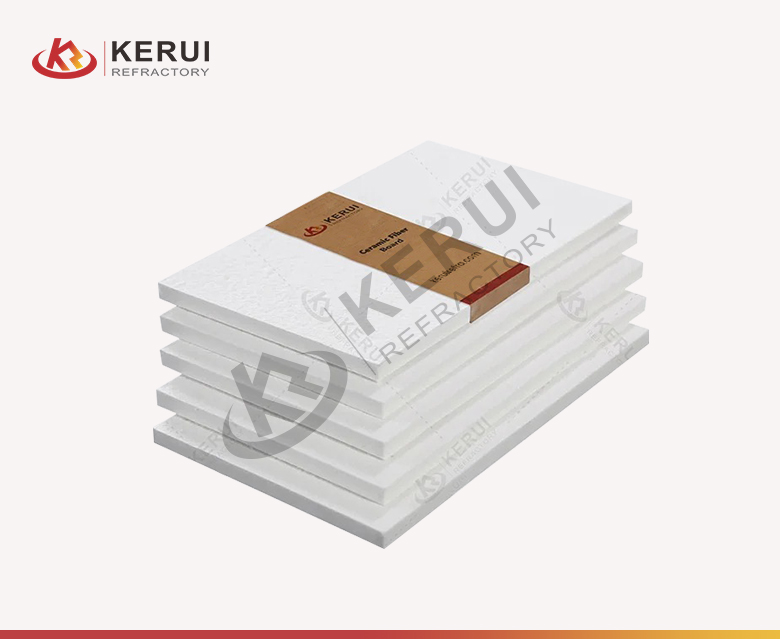
Ceramic Fiber Board
Advantages:
- Extreme Temperature Limit: High-zirconia grades can withstand 1,430°C and direct flame contact.
- Immune to Thermal Shock: Can be heated and cooled instantly without cracking.
- Low Heat Storage: Absorbs very little heat, saving massive amounts of energy in batch furnaces.
Limitations:
- Low Load-Bearing Capacity: Soft and compressible; cannot support heavy structural weight.
- High-Temperature Shrinkage: Will shrink slightly over time at absolute peak temperatures.
- Installation Dust: Cutting generates microscopic fibers, requiring strict respiratory PPE.
Head-to-Head Engineering Comparison
For procurement managers and furnace designers, here is the complete technical data comparison.
| Parameter | Calcium Silicate Board | Ceramic Fiber Board |
|---|---|---|
| Max Service Temperature | 1,000°C – 1,100°C | 1,260°C – 1,430°C+ |
| Cold Crushing Strength (CCS) | High (Rigid, bears heavy weight) | Low (Compressible, non-structural) |
| Thermal Shock Resistance | Poor (Cracks under rapid change) | Outstanding (Immune to rapid cycling) |
| Thermal Conductivity | Superior at lower temps | Superior at ultra-high temps |
| Density | 220 – 250 kg/m³ | 280 – 350 kg/m³ (Board form) |
| Price & Cost | Lower Initial Cost | Higher Initial Cost |
| Expected Service Life | 5-10+ years (if kept below max temp) | 3-5 years (degrades in harsh hot-face conditions) |
Industry-Specific Application Guide
Material selection must be driven by the specific mechanics of your industry.
1. Cement Industry
Winner: Calcium Silicate Board
In rotary kilns, the insulation layer sits directly against the steel shell and is buried under heavy working refractory bricks. It must withstand continuous mechanical vibration and the massive weight of the clinker. Calcium silicate provides the necessary rigid support while preventing the steel shell from warping.
2. Steel & Metallurgy Industry
Winner: Situational (Both)
For the backing insulation of a massive steel ladle, calcium silicate is preferred due to the intense hydrostatic pressure of the molten steel. However, for the doors and roofs of batch-type heat-treating furnaces that cycle from cold to 1200°C daily, ceramic fiber board is mandatory to prevent thermal spalling.
3. Glass Industry
Winner: Calcium Silicate Board
Used extensively in the bottom of glass melting tanks. The static pressure of liquid glass is immense, and calcium silicate prevents the dense working layers from subsiding while trapping heat effectively.
4. Petrochemical Industry
Winner: Ceramic Fiber Board
Ethylene cracking furnaces and reformers operate at extremely high temperatures and often require rapid shutdowns. Ceramic fiber boards (and modules) are used as the direct hot-face lining to handle the 1300°C+ heat and allow for rapid cooling without destroying the lining.
Kerui Field Experience: The “Composite Lining” Success Story
Can they be used together? Yes, and it is highly recommended.
Project Background: A petrochemical plant operating a large-scale heating furnace was utilizing a pure ceramic fiber lining. While it survived the heat, the furnace shell temperature remained too high (over 95°C), wasting massive amounts of fuel gas.
The Kerui Solution: Our engineering team redesigned the insulation architecture using a Composite Lining Strategy. We installed a 50mm Calcium Silicate Board against the cold steel shell (to provide a rigid, ultra-insulating barrier) and faced it with a 100mm high-purity Ceramic Fiber Board on the hot face (to endure the 1200°C direct flame and thermal shock).
The Results:
- The external steel shell temperature dropped from 95°C to a safe 60°C.
- Overall furnace energy consumption was reduced by 14.5%.
- The rigid backing of the calcium silicate prevented the ceramic fiber from sagging, extending the lining’s service life by an additional 18 months.
Frequently Asked Questions (FAQ)
1. Can ceramic fiber board completely replace calcium silicate board?
No. If the insulation layer must bear the structural weight of heavy working bricks, ceramic fiber will compress and cause the entire brick wall to collapse. Calcium silicate is irreplaceable for load-bearing insulation.
2. Which board has better insulation performance (saves more energy)?
At medium temperatures (below 800°C), calcium silicate has a slightly lower thermal conductivity and blocks heat better. At extreme temperatures (above 1000°C), the microporous structure of calcium silicate breaks down, and ceramic fiber becomes the vastly superior insulator.
3. Can ceramic fiber board directly touch flames?
Yes. High-grade ceramic fiber boards are frequently used as the direct working lining (hot face) in clean-energy, gas-fired furnaces.
4. Which one lasts longer?
If both are used within their correct temperature limits, calcium silicate board generally has a longer service life because it is rigid and immune to the gradual shrinkage and devitrification that affects ceramic fibers over years of extreme heat exposure.
5. Which one is easier to install?
Both are easy to cut and shape. However, calcium silicate is cleaner to install. Cutting ceramic fiber boards generates airborne silica dust, which requires the installation team to wear strict respiratory PPE.
6. Is calcium silicate board waterproof?
It has a water-repellent treatment during manufacturing, but it is not entirely waterproof. It must be kept completely dry during storage and installation to prevent cracking when the furnace is heated.
Conclusion
Choosing between calcium silicate board and ceramic fiber board is not about finding the “best” material, but finding the right tool for the job. If your primary engineering requirement is heavy load-bearing capacity in a stable temperature zone, calcium silicate is unmatched. If your operation involves extreme peak temperatures, rapid thermal cycling, or you need a hot-face lining, ceramic fiber board is the mandatory choice.
Because every industrial furnace operates under a unique set of thermal and mechanical stresses, guessing on insulation materials is a costly risk. If you need expert guidance to design an optimized, composite lining architecture, contact the engineering team at Kerui Refractory. We provide precise thermal calculations, custom insulation solutions, and factory-direct pricing tailored to your specific industrial requirements.
 Whatsapp
 WeChat